Why Hospitals Are Replacing Manual Transcription with AI
AI vs Manual Transcription: Why Hospitals Are Switching
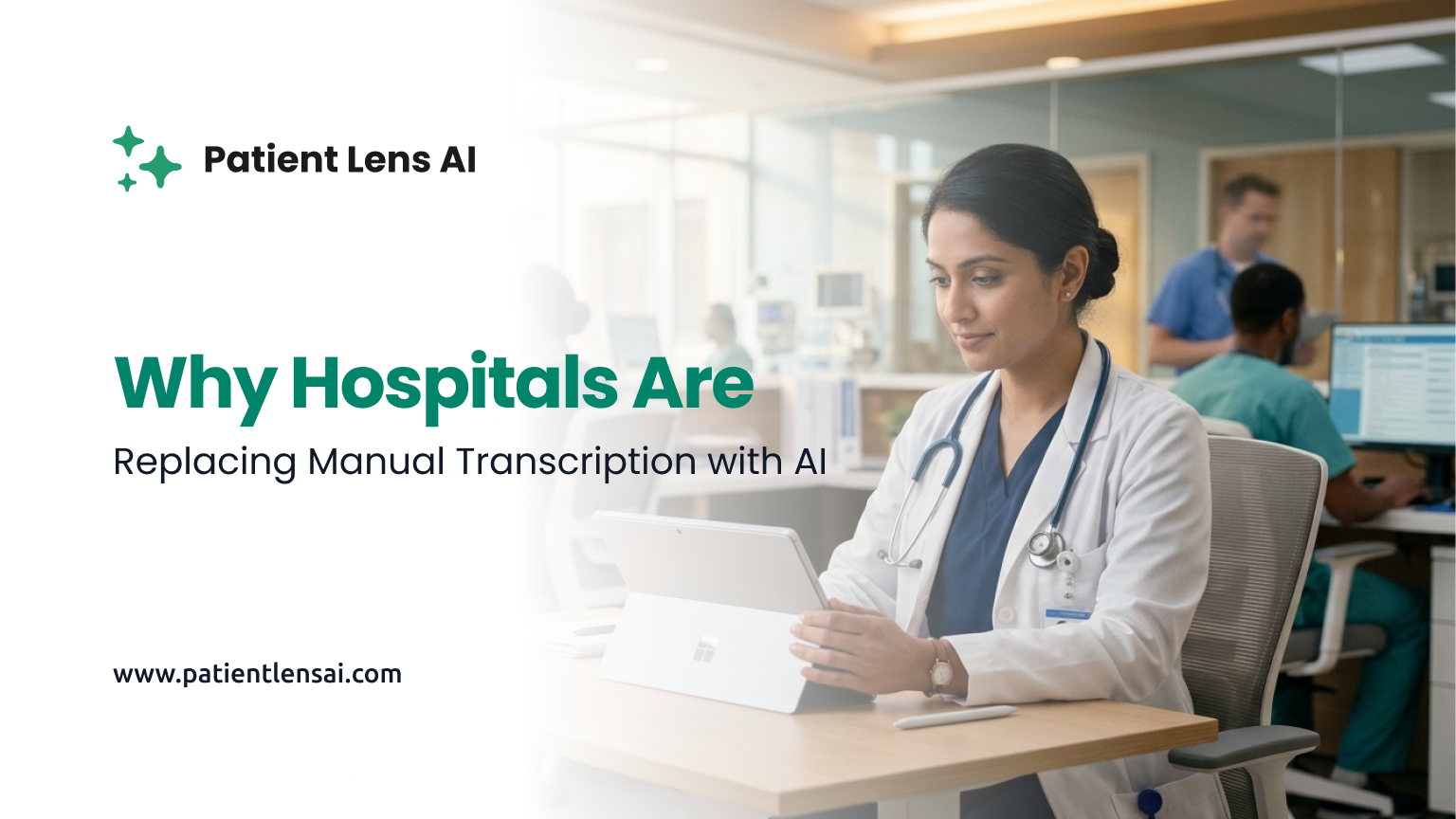
For decades, medical transcription has been a backbone of hospital documentation.
Doctors dictated notes. Transcriptionists converted them into text. Teams reviewed and finalized the documents.
It worked — but it came at a cost.
Delays. Errors. High operational expenses.
Today, hospitals are making a shift.
They are not just replacing transcription.
They are transforming how documentation is created, processed, and used.
At PatientLens AI, our mission is clear: help hospitals run smoothly and stay compliant with digital tools for discharge, claims, and medical records management. By replacing manual transcription with AI-powered documentation, hospitals achieve faster discharges, fewer claim denials, and improved operational efficiency.

Manual transcription involves converting doctor dictations into written records.
This process typically includes:
It is widely used for:
While familiar, this process is no longer efficient for modern healthcare demands.
Manual transcription creates a gap between documentation and action.
Doctors may wait hours — sometimes days — for finalized reports.
This delay affects:
Hospitals invest heavily in:
These recurring costs add up quickly.
Accuracy depends on:
Errors can occur in:
Even minor errors can lead to claim denials or compliance risks.
Manual transcription produces text — not structured data.
Hospitals still need to:
This creates additional workload for MRD teams.
AI-powered transcription uses:
to convert speech into structured documentation instantly.
Unlike manual workflows, AI operates in real time.
Doctors no longer wait.
They review and approve instead of starting from scratch.

Manual: Hours to daysAI: Seconds
Result: Faster discharge and billing processes.
Manual: Ongoing staffing and outsourcing costsAI: Scalable and cost-efficient
Result: Lower long-term operational expenses.
Manual: Variable qualityAI: Standardized, structured outputs
Result: Reduced errors and improved documentation quality.
Manual: Separate from hospital systemsAI: Integrated into workflows
Result: Reduced rework and improved efficiency.
The biggest shift is not speed — it is capability.
Traditional transcription creates text.
AI creates structured, usable information.
This means hospitals can:
PatientLens AI is not just a transcription tool.
It is a complete documentation intelligence platform.
It combines:
Doctors remain in control.
They review and approve every output.

Traditional transcription produces clinician-focused text.
But patients need clarity.
PatientLens AI generates two versions of documentation:
This improves:
A mid-sized hospital faced:
After implementing PatientLens AI:
Doctors spent less time on paperwork.
Administrators saw improved efficiency and ROI.

AI must enhance — not compromise — safety.
PatientLens AI ensures:
Hospitals retain full control at every step.
Replacing manual transcription improves:
The result is measurable ROI.
Better documentation leads to better financial performance.
Manual transcription cannot keep up with modern healthcare demands.
Hospitals need systems that are:
AI-powered documentation is becoming the new standard.

If your hospital is experiencing:
It is time to rethink your approach.
👉 Book a Demo with PatientLens AI today and see how AI-driven documentation improves efficiency, compliance, and patient outcomes.
Hospitals are not just replacing transcription.
They are redefining documentation.
With PatientLens AI, hospitals can reduce administrative burden, improve compliance, and create a smoother discharge process.
Because when documentation works better, everything else does too.
Manual medical transcription is the process of converting doctor dictations into written clinical records through transcriptionists. It involves recording, converting, reviewing, and finalizing documents, making it a multi-step and time-consuming workflow.
Manual transcription often results in delays, higher operational costs, and inconsistent documentation quality. It also creates dependency on multiple teams and increases the risk of errors in clinical details such as medications and dosages.
AI-powered transcription converts speech into structured documentation instantly using advanced technologies like speech recognition and natural language processing. This eliminates waiting time and allows doctors to review and approve content in real time.
AI uses standardized templates and structured outputs, reducing variability across documents. This minimizes human errors and ensures consistent, compliance-ready documentation across the hospital.
Hospitals experience faster discharge turnaround, reduced documentation costs, improved workflow integration, and lower administrative burden. This leads to better efficiency, improved patient experience, and stronger overall performance.

AI in Healthcare Writer
A writer exploring the intersection of healthcare, technology, and patient care, bringing clarity to complex topics through engaging storytelling.

A Smarter Approach to Discharge Documentation
Harish Goswami
Mar 14, 2026
5 min read
Smarter Medical Documentation for Hospitals
Harish Goswami
Jul 11, 2026
5 min read

End Discharge Delays with Patient Lens AI
Harish Goswami
Sep 01, 2025
5 min read

Why AI Discharge Workflows Improve Patient Outcomes
Harish Goswami
Mar 21, 2026
5 min read

Reducing Burnout Through Smarter Workflows
Harish Goswami
Feb 14, 2026
4 min read
Smarter Records. Better Patient Care.
Harish Goswami
Jul 18, 2026
5 min read
How smarter documentation can unlock revenue, efficiency, and patient trust
Harish Goswami
Oct 16, 2025
5 min read

Why Patient-Centric Discharge Summaries Are Now Essential
Harish Goswami
Apr 04, 2026
6 min read

Better Documentation, Better Patient Outcomes
Harish Goswami
Oct 24, 2025
5 min read