Is Paperwork Fueling Burnout Among Your Tier-2 Doctors?
Reducing Burnout Through Smarter Workflows
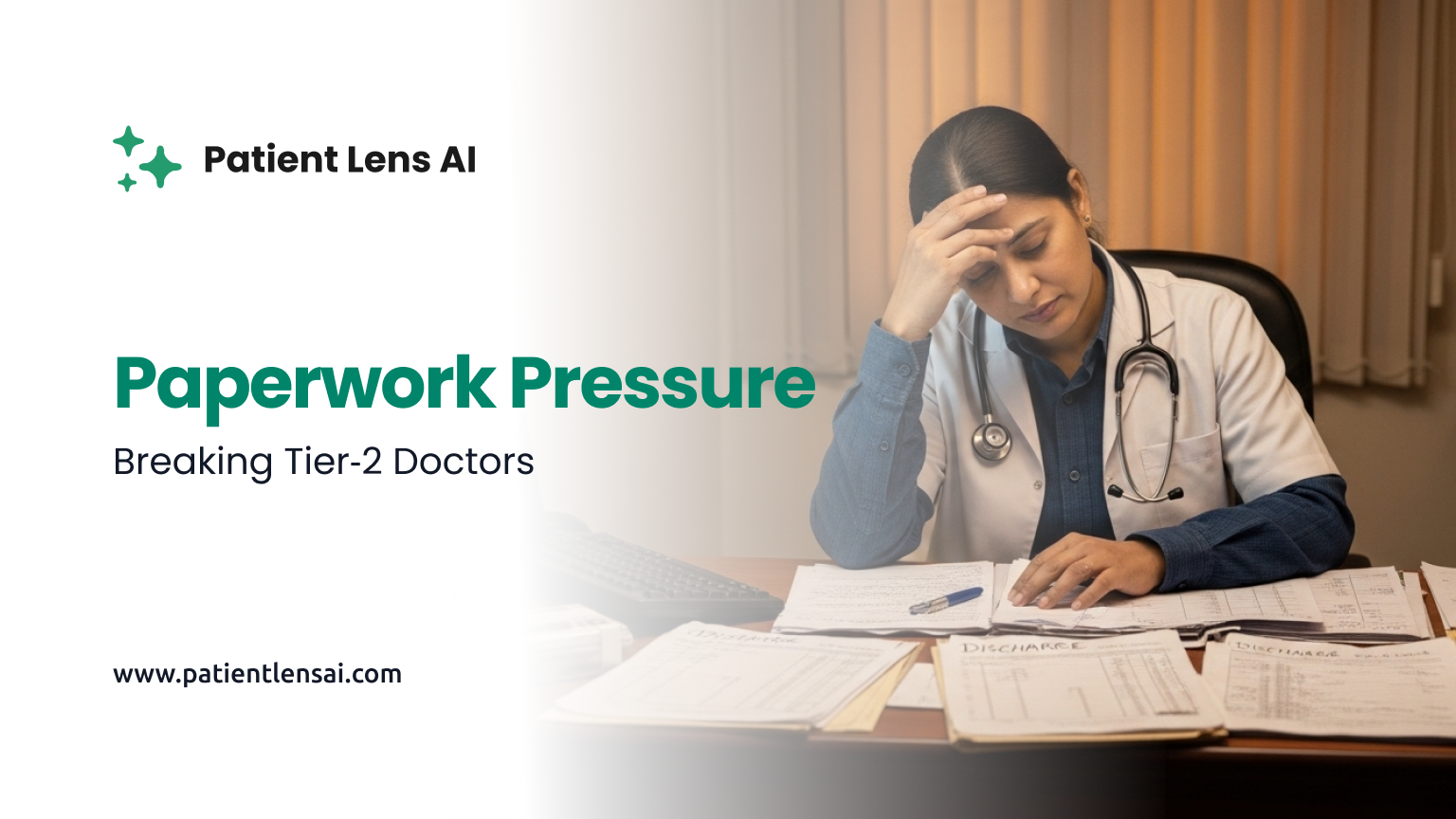
Doctor burnout in Tier-2 hospitals is rising — and paperwork may be the hidden cause. While long shifts and patient volumes are visible pressures, hours spent on discharge summaries, compliance documentation, and insurance paperwork quietly drain energy and morale.
What if reducing documentation time could help doctors leave on time, improve discharge speed, and keep hospitals audit-ready? With AI-supported workflows and built-in NABH/JCI-ready formats, hospitals can reduce administrative stress while maintaining full data control and compliance.
Doctor burnout is no longer limited to large metro hospitals. In fact, Tier-2 and Tier-3 hospitals may be feeling it even more intensely.
Long shifts, high patient volumes, and limited staffing already create pressure. But there’s another factor quietly adding to the strain: paperwork.
Discharge summaries, progress notes, compliance documentation, and insurance requirements consume hours every day. For many doctors, clinical care ends — but documentation continues long into the evening.
If your Tier-2 hospital is struggling with retention, morale, or rising fatigue among clinicians, it’s worth asking: Is paperwork fueling burnout?

Unlike large tertiary hospitals, Tier-2 facilities often operate with leaner teams.
That means:
In many hospitals, doctors are not just treating patients — they are also acting as document writers, format checkers, and compliance managers.
The result? A workday that doesn’t end when the last patient leaves.
Let’s look at where time is being lost.
In a typical Tier-2 hospital:
Doctors often stay late to “finish paperwork.” This administrative load contributes directly to emotional exhaustion and reduced job satisfaction.
Burnout doesn’t always come from patient care. It often comes from everything surrounding it.

When paperwork overload leads to burnout, hospitals feel the impact quickly:
Burnout is not just a personal issue. It is an operational and financial risk.
Many hospitals try to solve burnout by:
While well-intentioned, these approaches rarely address the core problem: inefficient documentation systems.
If doctors are spending hours on manual discharge summaries and compliance formatting, morale will continue to suffer — regardless of motivational workshops.

This is where Patient Lens AI offers meaningful relief.
Instead of asking doctors to work faster, it helps them work smarter.
Here’s how it reduces documentation stress:
Summaries are drafted in under 10 minutes instead of 4–6 hours. Doctors review instead of rewrite.
Formatting and mandatory sections are automatically structured — no manual double-checking.
MRD teams review and approve drafts, reducing back-and-forth corrections.
Hospitals retain full ownership and control of records.
Compliance documentation is maintained automatically, removing last-minute audit panic.
Hospitals using Patient Lens AI have reported up to 85% reduction in discharge delays, along with improved MRD productivity and smoother workflows.
When paperwork reduces, doctors experience:
One Tier-2 physician (anonymized) shared:"Earlier, I stayed back almost every day to complete discharge summaries. Now I review AI drafts in minutes. I finally leave on time."
That difference directly affects morale, retention, and care quality.
India already faces a clinician shortage. Tier-2 hospitals cannot afford to lose experienced doctors to burnout.
At the same time:
Hospitals must improve efficiency without increasing stress.
The solution isn’t more pressure — it’s better systems.

Paperwork should support care — not overshadow it.
By embedding compliance and documentation into intelligent workflows, hospitals can reduce administrative overload and restore clinical focus.
With Patient Lens AI, discharge summaries become faster, compliance becomes simpler, and doctors regain valuable time.
👉 Book a demo today to see how Patient Lens AI helps Tier-2 hospitals reduce burnout, improve discharge efficiency, and strengthen compliance — without replacing existing systems.
Tier-2 hospitals often operate with smaller clinical teams and limited administrative support. Doctors manage higher patient loads while also handling documentation, discharge summaries, and compliance tasks. This combination significantly increases workload and stress levels.
Manual documentation can take 4–6 hours per discharge in many hospitals. Doctors often complete paperwork after clinical hours, leading to long workdays, fatigue, and reduced work-life balance. Over time, this administrative burden contributes to emotional exhaustion and disengagement.
Yes. When doctors spend less time on clerical tasks, they can focus more on patient care. Faster, clearer discharge summaries also reduce readmissions, improve follow-up adherence, and enhance patient satisfaction.
No. AI assists in drafting structured discharge summaries and compliance documents, but final review and approval remain with hospital staff. The goal is to reduce repetitive work — not replace clinical judgment.
Patient Lens AI generates structured, NABH-compliant discharge summaries in minutes. Doctors review instead of writing from scratch. This reduces late-night paperwork, shortens discharge delays, and lowers stress across clinical teams.
No. Patient Lens AI is designed as a plug-and-play solution that integrates with existing HIS, EMRs, or even paper-based workflows. Hospitals do not need to replace their systems.
Yes. Patient Lens AI includes built-in NABH/JCI-ready formats, mandatory field checks, and complete audit logs. This reduces compliance-related stress while keeping hospitals audit-ready year-round.
Most hospitals observe faster discharge times and reduced documentation burden within weeks of implementation. Many report up to 85% reduction in discharge delays.

AI in Healthcare Writer
A writer exploring the intersection of healthcare, technology, and patient care, bringing clarity to complex topics through engaging storytelling.
A Smarter Approach to Discharge Documentation
Harish Goswami
Mar 14, 2026
5 min read
Smarter Medical Documentation for Hospitals
Harish Goswami
Jul 11, 2026
5 min read

End Discharge Delays with Patient Lens AI
Harish Goswami
Sep 01, 2025
5 min read

Why AI Discharge Workflows Improve Patient Outcomes
Harish Goswami
Mar 21, 2026
5 min read
AI vs Manual Transcription: Why Hospitals Are Switching
Harish Goswami
May 02, 2026
5 min read
Smarter Records. Better Patient Care.
Harish Goswami
Jul 18, 2026
5 min read
How smarter documentation can unlock revenue, efficiency, and patient trust
Harish Goswami
Oct 16, 2025
5 min read
Why Patient-Centric Discharge Summaries Are Now Essential
Harish Goswami
Apr 04, 2026
6 min read

Better Documentation, Better Patient Outcomes
Harish Goswami
Oct 24, 2025
5 min read